Transcript
ReachMD Announcer:
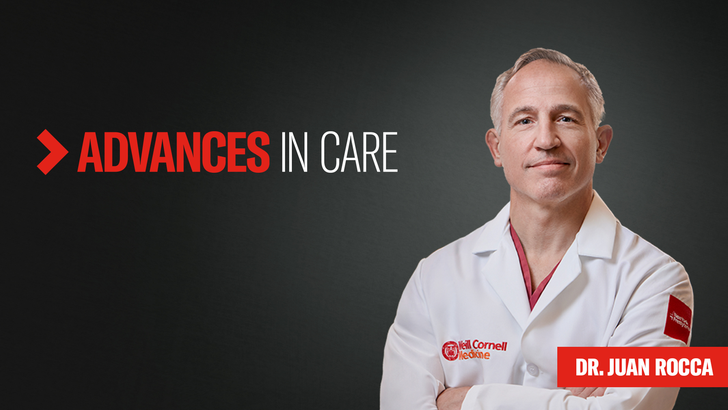
Welcome to ReachMD. This medical industry feature is titled “Pioneering a First in Robotic Liver Transplant,” featuring Dr. Juan Rocca, transplant surgeon at NewYork-Presbyterian and Weill Cornell Medicine. This audio is a production of New York-Presbyterian with world-class doctors from Columbia & Weill Cornell Medicine.
Erin Welsh:
Ever since he began his surgical medical training, Dr. Juan Rocca had a special affinity for the particular challengesof the liver.
Dr. Rocca:
The liver, not only holds a lot of blood, but has a lot of different type of blood vessels, has arteries that are high pressure vessels. So cutting the liver for surgery is a challenge because the potential for bleeding.
Erin Welsh:
The risk of blood loss means that even the most seasoned liver transplant surgeons face a crucial moment during every operation, when they have to connect the patient's blood vessels – temporarily secured by clamps – to the new liver.
Dr. Rocca:
The most scary part is when you sew the liver, you have the vascular clamps holding the blood. At some point you need to release the clamps and let the blood flow through, and then you see the real deal. Because if you're gonna have bleeding, it's going to be after you open the clamps.
Erin Welsh:
Recently, he was facing that very moment of truth – releasing the clamps after transplanting a new liver. Only this time, things were a bit different.
Dr. Rocca:
Can we control the bleeding robotically once we open the clamps?
Erin Welsh:
That’s right – control the bleeding robotically. Earlier this year, Dr. Rocca performed the first fully robotic liver transplant in New York City. He and his team at Weill Cornell Medicine are part of the vanguard paving the way for wide adoption of this groundbreaking approach. And he hopes that success will help usher in a new era of liver surgery.
Dr. Rocca:
It's our responsibility as liver surgeons to take liver surgery to this realm of minimal invasiveness and just create the evidence where there's no doubt that this is the way to do it.
Erin Welsh:
I'm Erin Welsh and this is Advances in Care, a podcast about groundbreaking developments in modern medicine.
Today, Dr. Juan Rocca, tells the story behind this landmark achievement in robotic liver transplant surgery. Dr. Rocca is a surgeon in the Division of Liver Transplantation and Hepatobiliary Surgery at NewYork-Presbyterian and Weill Cornell Medicine – a Division that is shaping new possibilities for higher standards of care for liver transplant patients.
Not too long ago, laparoscopic techniques were considered the cutting edge of abdominal surgery. Dr. Rocca spent years perfecting his skills – because complex laparoscopic liver transplants require highly skilled surgeons.
Dr. Rocca:
With laparoscopic surgery, you can give the benefit of minimal invasive surgery to many patients in many different surgeries. When it comes to complex operations in the liver, only a few very talented surgeons could do it and nobody else.
Erin Welsh:
He became one of those surgeons. So when robotic surgery became more widely implemented, about 7 years ago, he and many others wondered – is it worth retraining ourselves on a new technique when we’ve already mastered laparoscopy?
Dr. Rocca:
I was doing laparoscopic hepatectomies, laparoscopic measure hepatectomies. When you hone in a technique and you're good at something, you want to defend that technique. So when robotic hepatectomy became something that you should pay attention, it was 2018, 2019. At the beginning, the first reaction was to say, well, I can do the same, you know, operation with laparoscopy. And it's less resource intensive. I don't need a robot. I can do it myself, I'm skilled.
Erin Welsh:
But soon Dr. Rocca began to realize that adopting robotic surgery techniques for liver transplants could be revolutionary. Laparoscopic and robotic surgeries are both minimally invasive, and have less bleeding risks and faster, simpler recoveries for patients. But –
Dr. Rocca:
The robotic operation offers more surgical dexterity, better visualization, better surgeon skills through small incisions. When you are using the robot, you have a camera inside that gives you zoom, gives you the perfect lighting, you can see exactly how you are doing your connections between blood vessels.
Erin Welsh:
These technical advantages also mean that more surgeons can offer more precise and reliable operations to their patients who need complex procedures – and with minimal invasiveness, meaning less risk of bleeding and smoother recovery.
Dr. Rocca:
You see that you can achieve more consistency in what type of operations you can do with robotic platforms across the world and at the division level. That is, your entire surgical team can do it.
Erin Welsh:
He understood that bringing these techniques to NewYork-Presbyterian would elevate the quality of care that his division offered to patients, and democratize the skills required to do robotic surgery, across his whole team.
Dr. Rocca:
You don't want to have one person being the one that can do it, you want to have an entire team that can offer this. It's kind of a democratization of the surgical technique. And I think it's important to acknowledge that. Sometimes when you're a young surgeon, you think you can do everything yourself, but you know, if you don't learn how to work as a team you cannot go very far. And I think that is the same concept for robotic surgery, when you compare it to laparoscopy, if you want to do complex operations.
Erin Welsh:
And so, Dr. Rocca spearheaded an effort to embrace robotic surgery in the division. He started with living donor hepatectomies – an operation that can be done laparoscopically in healthy patients – and explored how to switch that method to robotics. It was a huge success and helped pave the way for the teamto do more complex operations, too, like removing livers from sicker transplant recipients.
Dr. Rocca:
When we decided to take robotic surgery as a division, we increased significantly the difficulty of cases. At the beginning of that seven-year period or before this transition, only one third of the hepatectomies that were difficult were being done either with laparoscopy or with robotic surgery, under 30%. At the end of the transition in 2023, for difficult hepatectomies, 70% done robotically and only 30% open and no more laparoscopy.
Erin Welsh:
Even though they’d managed an evolution from the laparoscopic approach to robotic surgery for hepatectomies, they hadn’t yet reached the final frontier – fully robotic liver transplant – when the risk of blood loss is immense. In many operations, they’d perform the hepatectomy with a robot, and then complete the procedure through open surgery.
But Dr. Rocca had been advocating for his whole team to be trained in robotics. He believed that with this new training across the department, they could all take the next step together.
Dr. Rocca:
Liver transplantation is a team sports effort. Nobody can do this alone. So it really reflects on that team effort, being able to do the most complex abdominal operation, which is a liver transplant, to be able to perform it robotically.
Erin Welsh:
With that expertise established, Dr. Rocca began searching for the ideal case to demonstrate the potential of this new technology.
Dr. Rocca:
Patient selection is key to succeed in the completion of the transplant robotically. And also to be able to show that there is a benefit for patients.
Erin Welsh:
In April 2024, he saw a patient who suffered from poor quality of life due to cirrhosis with decompensation. He’d had multiple infections, and fluid buildup in his abdomen. But, he could still walk and wasn’t extremely sick.
Dr. Rocca:
This patient was someone that was in the spectrum of severity, of disease was in the middle. It was probably a perfect case to start.
Erin Welsh:
Dr. Rocca says it was a case that was representative of a typical liver transplant. But of course – as with any liver transplant – the other crucial component is finding a matching donor liver.
Dr. Rocca:
Once you get the organ offer and you know who is the recipient, you can decide if that combination of the size of the liver graft and the quality of the liver graft and the severity of disease of the recipient are a good combination for attempting a robotic liver transplant.
Erin Welsh:
So, when a match became available, Dr. Rocca approached the patient with his plan to attempt the operation robotically.
Dr. Rocca:
When we approach the patient, we tell them about our experience with prior removal of the cirrhotic liver robotically, which were the prior cases, and that if the conditions are favorable once we do that and we feel that we can proceed with the implantation of the new liver and the vascular connections, that we are going to try to do it.
Erin Welsh:
A robotic liver transplant begins in a room that isn't so different from an open or a laparoscopic liver transplant.
Dr. Rocca:
Typically a room for liver transplant is a room that has some space, allows for machinery to fit in.
Erin Welsh:
In addition to the robotic console, the team needs other advanced equipment in the room with them. For example – a perfusion pump, a relatively new surgical tool that circulates blood through the donated liver to maintain its quality until it’s ready for transplantation into the patient.
Dr. Rocca:
This is something that we've been using for the last two years, is machine perfusion technology. This is when the organs are being recovered from a donor, we are able to put this on a machine perfusion pump that pumps blood through the liver. And you can keep the liver working outside the body for up to 24 hours. So, this is another thing that we use for transplants, for many other reasons, but in a case of a robotic liver transplant, we prefer to have the liver on a pump.
Erin Welsh:
And standing by is the perfusionist, the anesthesiologist, and all of the other staff who keep the operation running smoothly – like nurses, physician’s assistants, fellows in training – and finally: the robotic console.
Dr. Rocca:
We had a couple of rooms that, you know, allow us to fit the robot without struggling with space, but it's a kind of a more crowded room.
Erin Welsh:
It's a big team, and throughout the surgery they have to communicate. But the robot actually makes that communication easier.
Dr. Rocca:
When you are on the robot, you have a microphone and headset. So it's easier to hear everyone. And that actually is very important because you can be at the console looking at your screen and just talk to someone like you are having a coffee. Everybody listens and that keeps the tone very calm. Plus, you're seated, so you're in control of everything. It's really important to be calm when you're doing this stressful operation.
Erin Welsh:
The first step of the operation was to do a hepatectomy, to remove the patient’s failing liver – something that Dr. Rocca’s team had done many times robotically.
Dr. Rocca:
So we were doing the hepatectomy robotically, removing that old liver from a small incision and then you have the anhepatic phase where there's no liver, but you have to clamp blood vessels to be able to do the new connections.
Erin Welsh:
It was during that anhepatic phase, when the surgical team was making connections between blood vessels, that they had to make the critical decision – to complete the transplant robotically or convert to an open surgery.
We said, all right, we're going to give it, you know, 20 minutes. And if in 20 minutes we cannot set up the new liver and start sewing the way we feel that is proper, then we're going to get the liver out and put it back on ice and convert.
In previous operations, when the team had reached this moment – a patient with no liver and a donor liver ready to be sewed in – they had decided to convert to open surgery, because the cases were just too complex. But after the liver was out and Dr. Rocca had the patient's blood vessels ready to connect to the new liver, he checked in with the rest of his team.
Dr. Rocca:
I asked anesthesia, how are we doing? We're doing fine. Okay. I asked the surgeons in the team, how is everybody feeling about doing the next step? Are we okay? There's no bleeding. The vessels are under control, the liver size seems optimal. Should we go ahead? Yes.
Alright, let's rehearse. So then we took 30 minutes to rehearse how we were going to do the steps of putting the new liver in, putting some clamps to do some connections, what sutures we were going to use. And then we said, all right, we're doing it.
Erin Welsh:
Soon after, they were sewing in the new liver – with a robot. When they finished sewing, the team faced that crucial moment: releasing the clamps to let blood flow through the vessels again.
Dr. Rocca:
To say, all right, can we control the bleeding robotically once we open the clamps? And yes, it was as expected, and again, the nature of the beast in liver transplant is bleeding. So, there was some bleeding from the connections that we were able to control and you know, it was just fine. But these were the most critical parts of the operation.
Erin Welsh:
The collective focus of the team allowed them to cross that checkpoint and stick the landing.
Dr. Rocca:
One of the things that I was amazed was the silence during the operation. There was never a sense of chaos. Everybody knew exactly what we were doing and what was next, and there was no surprises. We were just executing what we had planned and just checking each other. If we could do the next step, we checked, we move on to the next step.
And I think that that's why I'm so proud of the team that we were able to attain in the last few years.
Erin Welsh:
After the nine-hour procedure, the patient began a smooth and swift recovery, thanks to the robot’s small incisions. Not long after the operation, he walked a mile around the hospital floor.
Dr. Rocca:
He was a very nice person. He was very grateful all the time. You could see his smile on the pictures. It was a perfect first case.It only took us three years to completely change the way we practice liver surgery here at Cornell.
Erin Welsh:
It took faith in the technology, and scaling fluency in robotic surgery among all of his team members.
Dr. Rocca:
You have to be committed, you have to believe that you can do more complex operations minimally invasively, and that's why you decide to do it. But also, you know, at some point, if you divide your experience between laparoscopy and robotic, you can never get the team fully trained into what you're doing as your highest complexity case. So at some point you need to make that transition to fully robotic surgery.
Erin Welsh:
It takes long-term commitment and continuous innovation. But fortunately, Dr. Rocca says he’s seeing widespread institutional adoption of the technology.
Dr. Rocca:
Thankfully here at, you know, NYP Cornell, we are well resourced and the organization is very committed to support robotic surgery. Now many surgeons are graduating from their training programs with robotic skills. We train fellows at our program and they're being trained in robotic hepatectomy.
Erin Welsh:
And so they can just hit the ground running.
Dr. Rocca:
Exactly. So this is a generational change.
Erin Welsh:
The big triumph, in Dr. Rocca's view, is proving that a fully robotic liver transplant is not only achievable, but could one day become the new norm.
Dr. Rocca:
You need to show that this is something that is reproducible, number one, that more people can do it. And we are actually, we are not the first doing this, but we are among the first in the country. We are only three programs in the country were able to do it. And of course it's a testament of how far we were able to come along with the technique.
Erin Welsh:
He wants other institutions to look to NewYork-Presbyterian and Weill Cornell Medicine as a model for the democratization of robotic surgery, to open more doors for patients who need complex liver surgery.
Dr. Rocca:
We take pride of what we did, but we really want to encourage others to transition to robotic surgery. We need to really show that this is better than what we do in open. And that requires many patients, many centers doing it. And that's [00:17:00] why we want to spread the word that this is worthwhile.
Erin Welsh:
Thanks to Dr. Juan Rocca for telling the story behind the first fully robotic liver transplant in New York.
I’m Erin Welsh.
Advances in Care is a production of NewYork-Presbyterian Hospital. As a reminder, the views shared on this podcast solely reflect the expertise and experience of our guests. To listen to more episodes of Advances in Care, be sure to follow and subscribe on Apple Podcasts, Spotify, or wherever you get your podcasts. And to learn more about the latest medical innovations from the pioneering physicians at NewYork-Presbyterian, go to nyp.org/advances.
ReachMD Announcer:
If you missed any part of this discussion or to find other programs in this series, visit ReachMD.com/industryfeature. This is ReachMD. Be part of the knowledge.